Ethics & Society
On Difference
Read moreThere is a special awareness that comes from reading old journals whilst jet-lagged; the words don’t seem any more profound, but the filter of strange tiredness certainly adds a layer of ‘did I write this? What was I thinking?’ which could be a positive or negative observation.
I wrote the notes below about ten years ago when considering how a very conservative religious institution (I had my former university in mind) could open a discussion on racial diversity. Much of this would apply to ethnic or interfaith conversations as well. All, of course, presupposes a level of openness to begin with.
Because of Violence (essay)
Read moreIn conjunction with yesterday’s poem, I’ve also submitted an interpretative essay on the writing process. I’ll not post the entire essay; however, here is a condensed version that outlines my rationale:
Having personally observed violent societies, spoken to victims of violence, and witnessed innumerable real and imagined acts of violence in the media—I have begin to consider potential remedies; what are the root causes? What is it about humans that give us this tendency toward violence? Is it innate or a learned activity? Last year, I began drafting a manifesto of sorts laying out my thoughts on the topic (with the aim to eventually expand the precepts into a book-length work). However, while the document is clear in its proposals, it lacks a certain vigour. For instance, the third proposal (which becomes canto three in the poem) states:Because of Violence
Read moreThis is part of a “creative assignment” for the MSc; we’ve been asked to produce a piece that speaks to an environmental or social issue. Alas, according of the vagaries of HTML, most of my utterly keen typesetting for this poem will be lost; some things are still better kept on paper. Here is a .pdf version of the poem with the intended formatting: Because of Violence
One
Because the world is a place of violence
—All life has value
What is the root of violence;
In what soil does it grow?
It taps down and breaks through the clay of life,
—Bodies and Earth alike
It grows—perversely alive, but is the end of living.Writing across borders
Read moreI’ve been indirectly involved with Atlantic Bridge for the past two years (beginning at a curriculum development workshop in Liberec, Czech Republic). My initial contact with AB came through Drs. Nathan Corbitt and Vivian Nix-Early of BuildaBridge International. Nathan and Vivian have consulted on the curriculum from the beginning and usually oversee the writer’s workshops. I am the Director of Communications for BuildaBridge; through a series of meetings concerning media planning and development, I was asked by Atlantic Bridge to come to the Netherlands for a short term and concentrate specifically on revising and finishing the Bridgebuilder curriculum. My professional training is in cinema production; however, I have moved increasingly toward communications consulting with a focus on writing and information design and welcome the opportunity to work on a project such as this.
Bridgebuilders Nutshell
Read moreI am currently revising a cross-cultural youth curriculum for Atlantic Bridge in the Netherlands. I was asked yesterday to write a one-page summary of the concept for general distribution.
The mission of Atlantic Bridge is to connect young people living in a climate of conflicting worldviews so they can develop personal expression and faith through cross-cultural friendships. Our primary way of doing this is through the “Bridgebuilders” concept. We combine a balanced cultural understanding with the mission of building bridges of friendship and faith. A fourteen lesson curriculum is the training method; while international festivals and other events co-ordinated by Atlantic Bridge bring young people face to face. As we work with high school students, we are careful not to make this heavily intellectual or theoretical, but rather a practical and experiential learning tool. Our aim is to make a targeted curriculum that prepares youth for the realities of a multi-cultural society; we equip youth to become the next generation of “complete” citizens in a world that needs people with these special skills.
Exchange Value
Read moreThe exchange I’ve been part of for the past week is now over; all the people involved have gone back to their homes and I have a moment to reflect on what’s taken place. I’m tempted to put the most positive spin possible on such meetings and I do believe that much was accomplished (perhaps more than what we, as leaders of the exchange, are capable of observing); however, I’m discouraged by what is really going on.
I want things to be simple; most people seek straightforward answers to a given question. There is a barrage of information, tasks, decisions, and considerations we must deal with every day. To add levels of complexity just bogs down the process of living. This is a common human trait; it’s true of an executive working in Chicago and a street vendor in Cairo. Otherwise we, as a species, wouldn’t get much done; we’d sit about thinking about the origins of the sugar-cube in our tea and the global consequences of cane trade, etc. I would just like my tea sweet and not have to think about someone slaving away in a field.Two from Palestine
Read moreThis is from an interview yesterday with two youth from Palestine on the exchange. Since Sunday evening, we have been at a hostel surrounded by forest in the Netherlands, far from the turmoil we’ve been discussing all week. In parenthesis, I have made some minor language edits for clarification; my questions are italicised. Again, this is only a brief selection of a much larger discussion which was taking part this last week; I believe, at least for the Palestinians involved in this exchange, that the major accomplishment of the week was to put their story into words. They feel confined and shut off from the world’s ear; just the opportunity to quietly sit down in a neutral place and unburden themselves of their story is a major relief. I think a portion of the violence we see portrayed on the news is a result of their feeling that nobody is listening and they’ve no other way to communicate their message. Hopefully the work we’ve done this week has given them a new voice and some tools to express their situation positively.
Peace and pistachios
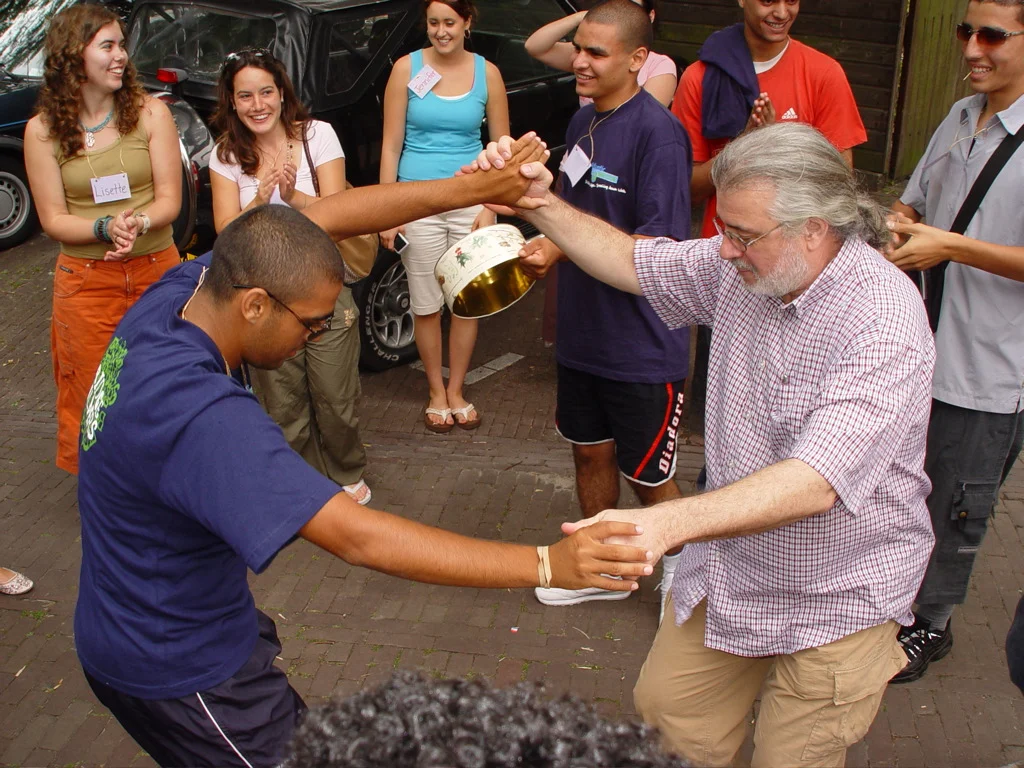
Read moreFor the past several mornings, each of the participant groups in this exchange have given a country presentation. Yesterday morning, the group from Jaffa spoke of hospitality in Islamic cultures. Though I have lived in the southern United States and experienced much warm hospitality there, I have a feeling a few weeks in a Muslim country might top the capabilities of people in Georgia and South Carolina. These are people with a deep-seated understanding of how to be hosts and consider it a mark of honour to welcome and care for guests. Last evening was a Palestinian meal; afterwards was dancing (very proper, men danced with men and the women with women) and some smoking from the hookah (not me). I’m sincerely struck with the contrast between how these kind joyful people express themselves so generously while living under such bleak circumstances. When asked about this today, they said some of their gladness for the moment comes from the respite they are experiencing here in the Netherlands. “Why are there only a few police in the streets?” “Where are the checkpoints?” “What documentation must we carry?” “How is it that these people live so freely?” These are questions asked in all sincerity. When you are from a place where one can be detained for hours for not having the right stamp or a policeman can pat down any woman in the street, I’d imagine coming to a country as open as the Netherlands would be almost shocking. We have to explain that, if there is a problem, you should go to a policeman; they here to help and you’ve nothing to fear from them.
Evening in Antwerp
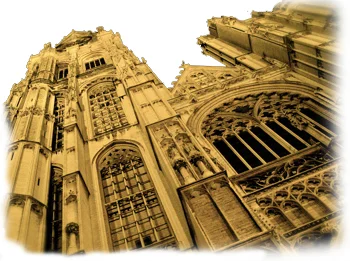
Read moreLast night, I went into Antwerp with John and one of the interns, Cammaria. We were to check out a youth hostel for the upcoming Muslim-Christian exchange. Ironically, the hostel is next to a synagogue in the heart of Antwerp’s large Jewish neighbourhood. John approached an Orthodox man on the street and asked if our group might meet with someone from the synagogue (one day in Antwerp is dedicated to a “faith safari;” the city has an extensive religious history). John first mentioned the youth were coming from Israel; however, when he clarified that the youth are from Jaffa and East Jerusalem, the man looked a bit incredulous. He said he would contact us though; hopefully there is an opening for discussion and some civility in the midst of all that’s going on currently in and around Israel. Unfortunately, conflict is a sticky thing that clings to the feet of those who travel. No matter how far one tries to walk away, there seems to always be some vestige of it left. In 1981, in peaceful Antwerp, the Synagogue was hit by a car bomb; I’m sure the wound of that is not forgotten or completely healed. I wonder how the Jewish people living there will react to a group of Palestinians coming into their midst; I wonder what will go through the minds of the Palestinians as they walk through the middle of the Jewish town, surrounded by Orthodox Jews and billboards in Hebrew, to get to our meeting location.