Ecology
Democracy Inaction
Read moreI have, along with everyone else in Sydney, spent the last month and more dealing with smoke from bushfires across the state. This is however, obviously not the worst of the national disaster we are now in the midst of as there are countless families who have been burnt out or displaced in rural areas and even some suburbs of cities, millions of animals dead with some pushed to the edge of extinction from habitat loss, and over 5,900,000 hectares (15,000,000 acres) of forest and bushland up in smoke. The relentless news of this ‘new normal’ is really starting to wear on me (as is the heat; I did have plans to do some small projects and travel over the holidays but find myself just escaping in my flat under fans or A/C). Also, the places I was thinking of going are either on fire or blocked from road closure and evacuation. What are we to do other than taking short showers and having a bucket under us as we do? This afternoon I wrote my local MP, Linda Burney about my concerns. I’ve met her a couple times and know that these sentiments are already what she advocates for in Canberra; but I think it’s important as a citizen of what’s ostensibly a functioning democracy to voice them regardless:
The story makes the world
Read moreI studied film production in University; our directing teacher was the venerable Dr Katherine Stenholm. One day in class she made this statement about filmmaking which, at the time, seemed ludicrous, “We make reality.” To my young indoctrinated mind, that was beyond our human capacity; God made reality and it was so. However, I’ve grown to understand more of the nuance of what she meant. This morning I read George Monbiot’s excellent Weekly Review article in this week’s Guardian. His title and premise is, It’s time to tell a new story if we want to change the world. He articulates much of what I’ve been ruminating recently about our individual and collective need for a better story from which we live.
Coming by Sea to Hope and Distress
Read moreWood that turns to stone,
That turns to bone
At the bottom of the sea;
Flotsam in the ocean,
Like the great raft
Of rubbish that is
Part of what we have
Discarded—too difficult
To address but distant enough
To ignore.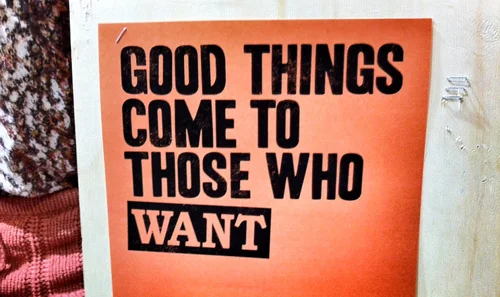
Freedom from want
Read moreThere are two contradictory maxims enshrined in ‘our’ world:
- It is my purpose to desire and acquire more,
- I am free from material responsibility.
Last month, I spotted the sign above in a Sydney clothing store. It’s the hybrid of these two statements; but like many man-made hybrids, it can’t live at ease with itself and carries its own maladies.
2008 Big Tent Festival
Read moreLast weekend I attended the Big Tent Festival Scotland’s Festival of Stewardship (seemed like an apt place to research my dissertation topic). I basically wandered around the festival sticking a microphone in people’s faces and asking about their concept of stewardship. There were some surprising answers (one of the exhibitors had no idea what a steward is; she thought it was just the person directing traffic at a football game). Most people though had some personalised concept of stewardship (either they thought of themselves as stewards or could verbalise what the responsibilities of a steward would be).
In a discussion with one of my professors (sitting by hay bales at the organic food stall), I had a bit of an epiphany concerning my research; at the outset, I had hoped to come up with a definitive definition of stewardship—something that would be applicable in any context. However, it is such a personalised concept that this might not be either possible or desirable. It’s rather like discussions on faith; if you are dogmatic and say it is just this one thing and nothing else, the discussion becomes closed and static. If one allows an “amorphous” definition of stewardship that can evolve and become personalised, everyone can come to the table and share in the idea.A turbine for the community
Read moreThis is the second discussion session I attended at Friday’s Transition Town meeting.
A community wind farm turbine purchase
This session was on the community purchase of a wind turbine in a new development in Fintry (Scotland). A developer approached the community with a plan to build a 14 turbine wind farm; the community proposed an additionality that they would purchase a 15th turbine and receive income from the electricity generated. They found funding and purchased the turbine for £2.5 million (turbine was originally expected to pay itself off in roughly 15 years; however, as electricity prices are increasing, the return on investment time is growing shorter. It will, again depending on electricity prices, generate an income of £50 to £100,000 a year till it is paid off then £400,000 to £500,000 a year for the community).Think before consuming
Read moreOver the past few days I’ve been at The Big Tent: Scotland’s Festival of Stewardship. On Friday, before the festival started, I attended a Transition Towns meeting. I’ll present notes from two discussions; first is a conversation about consumer culture:
Think before consuming
The session was mainly concerned with how to raise awareness about waste and energy involved with the production and packaging of “plastic rubbish” (this term was used several times through the conversation to indicate anything from flat-pac furniture to toys that are used briefly and then thrown out). We considered the social implications of becoming “that mother who doesn’t want her children to give or receive gifts from the store” and what misunderstandings and opportunities might arise from taking a “non-consumer” or contrarian stance on this issue.The Call of the Suburb
Read moreHere is an excerpt from an essay I’ve just finished for the Ecopsychology module of my MSc in Human Ecology.
“The soil and the pavement grow different crops, even though the soil is cut up into minute suburban plots.” – Harlan Paul DouglassOne Step Removed
Perhaps humans were never meant to live in cities; arguments against are based on the theory of our evolution in small groups—that these cannot be scaled to a metropolis. (Rees, 37-40) However, counter-arguments propose we can construct cities as groupings of small self-contained communities that mimic our evolutionary background (see Ackoff on his model for new urban design). Some contend our only “natural” living space is the countryside; yet the countryside as we know it is almost always a man-made (or heavily altered) construct. If one considers the countryside a wild place, one might imagine the suburb as a happy middle-ground—not urban, not wild, but a median of the two. However, in this paper I will propose the suburb is perhaps the most unnatural amalgam of environments we have yet devised. In the city, we can at least see some shadow of our prior organisation into small communities with shared space for common use. In the country, we often organise into groups that provide mutual benefit (farm collectives, fire brigades, etc.). However, the suburbs tend to separate out each family or individual into an isolated unit (an isolated unit that relies heavily on outside resources for maintenance). If one is habituated into such an environment where everything and everyone is siloed off into discreet controlled elements, what is the psychological impact? This essay will briefly explore this and some reasons behind the growth of contemporary suburbs.Community
Read moreI’m a few days back now from the Isle of Eigg (one of the small Hebridean Islands; 7,400 acres with about 80 people—and a stunningly beautiful landscape). We were there for a core course on the MSc.
There is a lot I could (and probably should) write concerning our visit there; one of the primary reasons we visit Eigg is to observe the workings of a small community—how they interact with each other and their environment. I’m supposed to be able to parse this all out and write about it; however, as I’m becoming more aware of issues of legitimacy (the “who am I to come in here and think I can tell these people anything” question) and just generally sensitive to the spirit of a place, I feel less inclined to write (probably not the best reaction on an academic course!). I think I’m better able to experience a place and appreciate it than I’ve ever been before (and keep in mind that I’ve now had a lot of training to do this). But am I competent to tell someone else’s story; this is the question I am working through. (This is one of my learning edges for the course.)Gaia Embodied in a Voice too Soft to Hear
Read moreI wrote the first stanzas of this several weeks ago and finished the last few in the wilderness of Knoydart (I think there is a “missing” stanza yet to come). Here is a .pdf of the poem with proper formatting: Gaia Embodied.pdf
In the MSc course I’m on, we’ve spoken much about finding voice—about trying to find words to relate the human condition. I believe poetry is the language one uses to express what can’t be said with words.